


For those who didn’t read Part I, we have named the first act of a story ‘Context’. Context includes the start of the story and is concluded by the story’s ‘Catalyst’ moment. The catalyst being the point when the real and enduring stakes of the plot have been established, and the character’s status quo shifts, due either to a key choice or environmental disruption. For a quick refresher, see this illustration from Part I.
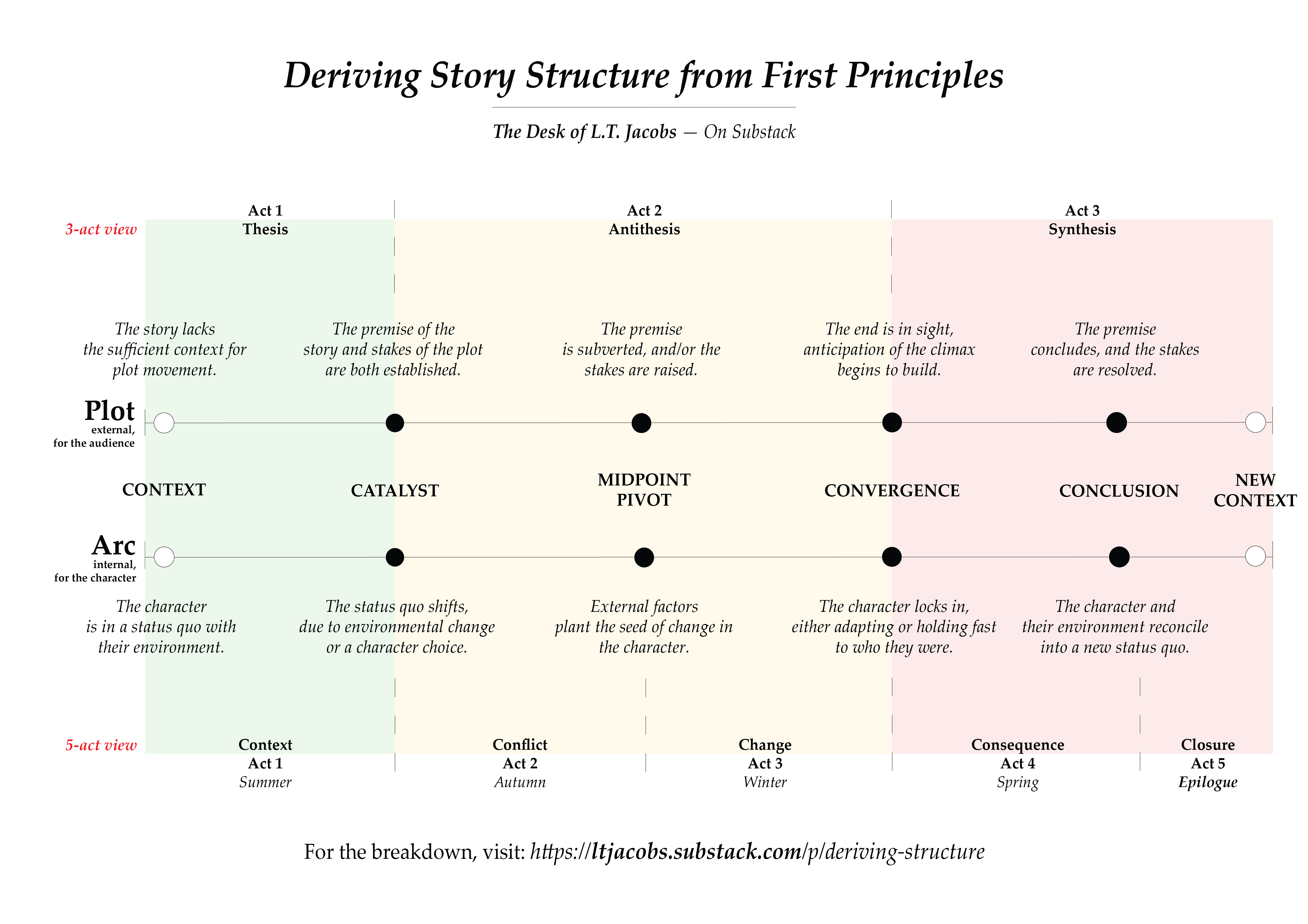
the big bang.
Classic explanations of story structure generally describe the first act as a time of peace or apathy. The mundane character—usually referred to as the ‘hero’—lives in a small corner of the typically fantasy-styled story world, and continues living that way until a ‘call to adventure’ comes by. Now, while the often fantasy-infused terminology is irksome, there’s nothing strictly wrong with a first act steeped in a safe, comfortably numb, mundane status quo—Fight Club (1999) spends its first act doing this and very little else. Even the term ‘status quo’, however, can reinforce the misconception that a first act must be static. Many stories work this way, yes, but some stories start off with a bang, making it hard to distinguish the status quo from the catalyst of the plot.
Take the film Crank (2006), for example. In the very first scene, mob hitman Chelios is fatally poisoned and does not have long to live. In the hands of another screenwriter, this would be the catalyst—a sudden and desperate moment arrived at only once we are sufficiently familiar with, and invested in, the character and his world. In the break-neck storytelling-style of Crank, however, the fatal poisoning represents merely the status quo of Chelios.
Let’s go deep on that for a second, because this is important:
In the fictional world of Crank, “poisoned to death” is not the natural state of Chelios—he is very clearly in anything but status quo with his environment. In the story world of Crank, however, “poisoned to death” is the status quo of Chelios. “Poisoned to death” is how we the audience first meet him as a character. From the audience’s perspective, a poisoned Chelios is the only Chelios we ever know.
Crank, of course, still has a catalyst. If a fatally poisoned Chelios is the ‘natural’ pre-catalyst Chelios, then the actual plot catalyst comes a quarter into the film’s runtime when Chelios confronts his boss, Carlito, and learns that this “Chinese shit” he’s been poisoned with has no cure, and that his death will serve as an appeasement of foreign allies. That is the real story of Crank. Not a man poisoned—a man incurably poisoned by his own employer. Sufficient context has been provided, the stakes firmly established, and the man-on-fire revenge plot now has clear direction.
Buried (2010) is another screenplay that opens with the protagonist waking to immediate peril—Paul Conroy wakes up in a coffin. The protagonist does not grasp the full context of his predicament, and the audience, similarly, has no idea who Paul is, how he wound up here, or where the story is therefore headed. Only when he learns that he’s been put their by terrorists, ransoming his life for $5 million dollars, has the catalyst occurred.
We can think of this in terms of layers. A first act predicated on mundanity is adding layers of context until we reach the catalyst. A first act predicated on confusion, on the other hand, sees the writer peeling back layers of confusion to reveal the catalyst. In both Crank and Buried, neither peace, mundanity nor apathy were ever part of the equation, because the status quo is relative to the rest of the story. This is why, in my prior illustration of structure, I call this act ‘Context’. In short, normality does not define the first act.
The first act defines normality.
rearranging deck chairs.
Consequently, deciding when in the timeline of events to start a story is a profoundly important decision, as we’re defining normality for the rest of the story—a decision which will have cascading consequences for the rest of its structure. A useful exercise is to imagine rewriting familiar stories with a new relative normal, by bringing later story beats forward.
Take The Hunger Games (2008), for example. What’s the catalyst? Traditional logic might say that it’s the first time Katniss makes a ‘profound choice’—to go as tribute in her sister’s place. But the Reaping and even the Games are ultimately just a backdrop to the actual story, as in most dystopian fiction. The Hunger Games has more on its mind than just survival—namely, romance and politics. Surviving the games isn’t plot, it’s context. The actual story is about the uncertain relationship between Katniss and Peeta. Using this lens, we can see that the novel’s catalyst comes when they choose to use a faux-romance as a part of their survival strategy.
Context—Katniss and Peeta are reaped for the annual Hunger Games.
Catalyst—Katniss and Peeta stage a fake romance for mutual benefit.
Midpoint—Peeta has an opportunity to kill Katniss, but instead protects her.
Convergence—Katniss decides to ally herself with Peeta against the remaining tributes.
Conclusion—Katniss and Peeta swear a tragic romantic death pact.
New Context—Peeta’s genuine feelings for Katniss are unrequited.
Let’s do a thought experiment. Imagine a version of the novel that opens cold with this fake relationship being performed for a televised audience. This throws the whole story into a different whack, as the cut plot points must be revealed retroactively. First, the audience will quickly realise that this ‘relationship’ is a political farce. Later, the audience will also deduce what the Reaping was, how it unfolded and what the Games actually entail. But what to do with this extra act’s worth of structural time? Well, we’ve got essentially three options. We could:
Extend the pre-Games politics. Pushing back the start of the Games to the midpoint, as in the film adaption, allows more time for fleshing out the political intrigue. In this version, the new catalyst might be when Peeta decides to train without Katniss, signalling that he may have decided to be an immediate adversary in the arena.
Extend the in-Games action. Bringing the start of the Games forward to the catalyst position means more time in the arena itself, putting more focus on the action—less setup means more blood, after all. The original Japanese novel Battle Royale (1999) takes this to an extreme with the child-murder ‘Program’ commencing barely six chapters in.
Create a new post-Games finale. This moves everything forward, with the conclusion of the Games marking only the point of narrative convergence, creating space for a new final act. The Hunger Games prequel, A Ballad of Songbirds and Snakes (2020), does this, using its post-Games third act to conclude the relationship arc, thereby shifting the overall focus of the story further towards romance. Alternatively, other uses for this new final act might be to resolve other stakes beyond the arena, such as an escape from the Capitol itself or revenge on the benefactors of the Games.
I hope you enjoyed writing fanfiction with me. None of these versions are better or worse than the original, they just weigh the attention of the story differently. What is lost in all of these alternatives is the melodic pace of the first act, where exposition is received as it is relevant, and not retroactively. The faster pace risks less emotional investment in the characters, in exchange for gaining more narrative time to be put to use elsewhere. What is common across all three of these rewrites, however, is that the new first act is creating a deliberate, temporary disorientation in the reader, as they slowly piece together the context of the world and the relationships of its characters.
This takes us back to the ‘layers’ analogy. The original book carefully and logically built each brick of the story structure. The three rewrites all start us on the second floor and ask us to infer exactly what the foundations are made of.
Now, with all this talk about moving and shifting parts of stories around, we must caution ourselves. Anything can be a catalyst, but that doesn’t mean anything is a catalyst. A story’s catalyst is frighteningly easy to misidentify, and doing so means building a home on shoddy foundations. I would know, I’ve done it.
missing the point.
In an early draft of Makeshift Minds (2025), I got feedback from a few beta readers that Seamus’ story arc only really hooked them about halfway in—which is to say—the story only really ‘got going’ at that point. Naturally, I was outraged. How was this possible? Seamus has a satellite fall from space and crash into his apartment in the second chapter. How has the story not started at that point?
In hindsight, it’s obvious that the scene with the falling spacecraft, despite the drama of it, was not his catalyst. It did not propel the story forward. It did not establish the real and enduring stakes of the story. It inconvenienced Seamus, yes, as he had to start sleeping at work, but it’s only as a consequence of sleeping at work, that he discovers his manager is actually an android and that there’s more going on with his employer than he realises—that his story begins. Everything prior to that is setup. Naturally, the consequence of this was massive. By treating the satellite scene as the catalyst, the true catalyst was pushed to halfway through the novel, as if it was a midpoint.
In short, I was drowning Seamus in setup.
Correctly identifying our plot’s catalyst is about finding the change in the story world that actually matters. The film Tenet (2020) is a high-profile example of a film failing to use its catalyst well. Tenet’s catalyst, depending on your perspective, either happens so early or so late, that the film spends half its runtime introducing a series of characters, but at no point conveying to the audience which of them is important. Only late in the runtime, after the villain’s wife is still in the movie, do we eventually realise—retroactively—that she was important and effectively drove the plot. The result is a sense of pacing so out of whack we begin to gaslight ourselves into thinking we surely must have just missed something.
Ultimately, Tenet’s problem isn’t complexity, but its muddled communication with the audience. We wade through a sea of exposition in search of a catalyst to anchor us, but by that time, the film is more than half over and our attention and interest has worn dangerously thin. If a reader reaches our supposed catalyst and is still saying “I don’t really understand what I’m meant to care about”, then that was not our catalyst. A poorly deployed catalyst is a failure to implicitly convey to the audience that, yes, this is the story now. Even if that promise is later subverted by an explosive midpoint, the audience would like to at least believe that they’re on the right track come this point in the story.
character change.
Now, I’ve talked a lot about the external perspective on the catalyst—plot—but not so much on the internal perspective, as it relates to a character arc. Come the catalyst, a character arc has begun, but character change usually has not. The environment has shifted to challenge the character, but for the meantime, they attempt to continue on as they are and refuse to evolve. The stimulus for change is not great enough yet.
The catalyst of the plot and the catalyst of the character arc often occur simultaneously, but not always. As I wrote in Part I,
In The Great Gatsby (1925), Gatsby’s character arc is the plot. They’re one and the same. As such, it follows traditional structure, with Gatsby’s catalyst coming in Chapter 4, when he enlists Nick’s help to win Daisy back. In other kinds of stories, the storyboard can be a bit ‘messier’, as the plot and character arc aren’t consistently attached to one another.
In Puss in Boots: The Last Wish (2022), for example, Puss’s personal catalyst (the bounty hunter) comes in hot in the third scene of the film, but the plot catalyst (the map to the wish) only comes in at the runtime's quarter mark. This gives the first act plenty of time to delve deep into Puss’ emotional downtime, before the plot kicks in.
Yes, I’m comparing Puss and Gatsby—don’t fuck with me, I’m clearly unstable.
As we’ve said before: plot is for the audience, arcs are for the character. The plot of Puss in Boots ensures that key developments occur at regular intervals, retaining audience engagement through an even sense of pacing. This frees up the character arc to fit in where it needs to—where it wants to—unstuck from the plot and without fear of messing up the pacing.
But what if we took this ‘unstuckedness’ to an extreme?
Iron Man (2008) is composed of essentially two separate character arcs for Tony Stark, compressed into one film. Most of Iron Man is a fairly plot-driven superhero origin story, but the first forty minutes—the first act—takes us through a whole other character arc for Tony from literal war profiteer to billionaire philanthropist. Where first acts normally show us who a character is by demonstrating their existing traits, Iron Man shows us who Tony is by having him change entirely in just one act.
This is, in some sense, a character arc being radically unstuck from the plot. Yes, it stands to reason that having our character arc unfold approximately in step with our plot will result in a story that maximally engages the audience on both a kinetic and emotional level throughout—but that’s perfectly subjective. Perhaps we might make the deliberate choice to save all our character development for the last few chapters. As demonstrated by Iron Man, as long as we’ve got our plot doing its job, we’re fairly safe to experiment.
Ironically, the major character arc of the film is arguably less compelling than the first act, due to the lesser relative ‘distance’ travelled by the protagonist as a person. Tony radically changes in those first forty minutes, whereas the next hour and twenty minutes see him evolve him from ‘billionaire good guy with a cool suit of armour who wants to use his business to help people’ to ‘billionaire good guy with a cool suit of armour who uses his business and said cool suit of armour to help people’.
While I’m hesitant to rewrite a film that grossed over $500 million and kicked off a $30+ billion franchise, but there is probably a version of Iron Man that stretches his most significant character development over the entire film, giving more emotional significance to his eventual donning of the red-and-gold armour. You know what, fuck it. I just rewrote The Hunger Games screenplay adaption multiple times and that film grossed $700 million, so why grow a sense of modesty now? I’ll put this second thought experiment in the comments.
coming soon.
So, that was context and catalysts. In the next part of this series, we’ll discuss further the shift into conflict and the midpoint—also known as, probably the best scene in basically every narrative, but also the easiest pillar to entirely overlook.
Until then, be good!
Makeshift Minds—OUT NOW

Indeed, the rumours are true. Makeshift Minds, the psychological debut of The Seamus Records, is out. Some might call it Dirk Gently meets Event Horizon. Some might call it The Hunger Games but written by Christopher Nolan if Christopher Nolan was demented. Others might call the police. Either way, it’s now out on ebook, paperback, and, if you pay me enough, possibly skywriting.
First, a quick recap of Iron Man (2008):
Catalyst—Fresh off his escape from imprisonment in a proto-Iron Man suit, Tony declares to the press that he is taking his company in a new, more humanitarian direction.
Midpoint—Tony performs a test flight with his first Iron Man suit, in a thrilling and euphoric sequence for the film.
Convergence—Tony synthesises into the titular red-and-gold hero, protector of the innocent, but his true enemy is revealed to be his business partner, Obadiah
Conclusion—Tony fights Obadiah to the death, successfully.
Epilogue—Tony declares to the press, “I am Iron Man”.
Now, as we’ve talked about earlier in this series, the concepts of ‘character-driven’ and ‘plot-driven’ are not mutually exclusive. They exist at two ends of a spectrum, with the vast majority of stories falling somewhere between the ends. Iron Man is not NOT character-driven, but is more interested in being a fun, bombastic blockbuster than it is being a harrowing character study. So, as another thought experiment, let’s this time move the catalyst of Tony’s character arc backwards into the later stage of the film, and see what could have been.
Catalyst—Tony escapes captivity, now determined to figure out how his weapons ended up in terrorist hands.
Midpoint—Obadiah turns out to have been selling his weapons on the black market, but tells Tony that it’s all just “good business”.
Convergence—Tony declares to the press that he is taking his company in a new, humanitarian direction, sealing Obadiah’s fate as an adversary.
Climax—Tony fights Obadiah to the death.
Epilogue—Tony declares to the press, “I am Iron Man”.
These aren’t dramatic changes, ultimately, as much of film remains intact, but the impact on Tony’s character arc is significant. The new catalyst sets up Tony’s central conflict, but withholds character growth. This revelation at the midpoint plants the seed of change in Tony, sending him spiralling into depths of transformation. The convergence point sees him emerge synthesised and clear on his new values, whatever the cost.
This alters the context of the Iron Man’s final act, as it’s the now the first time we see Tony having embraced his heroism. I may also move Tony’s first test flight backwards into the convergence point, so that the joy and catharsis of that moment mirrors his character’s synthesis into ‘humanitarian Tony’.
Is this a better film? Again, no. It’s just a different one, with different focuses and different priorities. This version lends itself less to summer blockbuster, which, for a superhero origin story, could feel like a failure to ‘understand the assignment’, as the kids say. But the experiment does again highlight the impact that the catalyst has, as it sets the stage for the character arc. Ending the first act with ‘baseline Tony’ established as ‘humanitarian Tony’ versus ‘arms dealer Tony’ has massive ramifications for the trajectory of his character arc for the rest of the screenplay.
Or whatever.